How Athens Heart Center Manages Statin Intolerance in High Risk Patients
A science based, whole person, shared decision making approach to elevated LDL, ApoB, and Lp(a)
Introduction
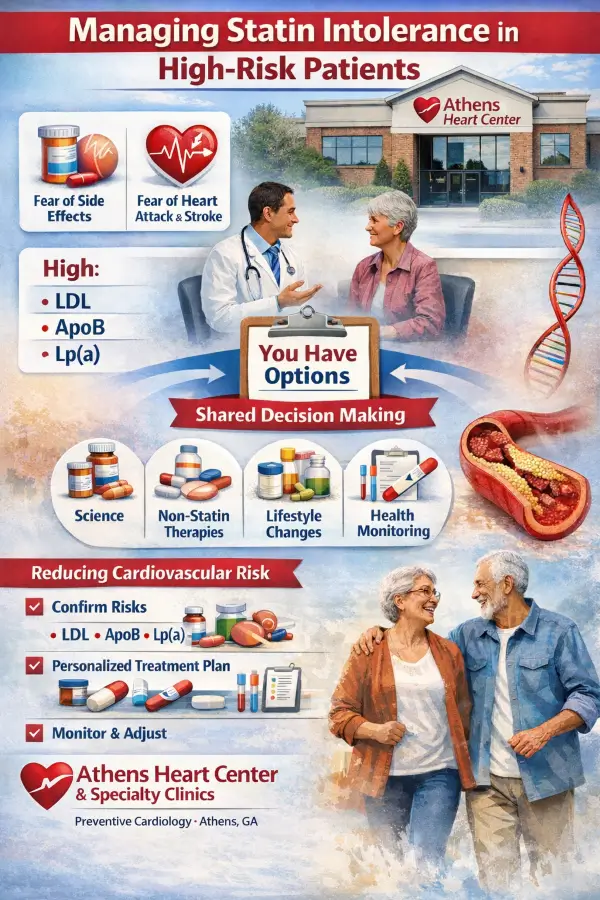
If you have been told that you are statin intolerant and your reports show high LDL cholesterol, high Apolipoprotein B, and high Lipoprotein(a), it is natural to feel stuck between two concerns.
On one side is the fear of side effects. On the other is the fear of a heart attack or stroke.
At Athens Heart Center and Specialty Clinics, we want you to understand one thing clearly.
You are not out of options.
You should never feel forced to choose between suffering through treatment or doing nothing at all.
Our approach focuses on reducing cardiovascular risk in a thoughtful and personalized way. We aim to protect not just how long you live, but how well you live.
Why This Risk Pattern Matters
- Elevated LDL cholesterol
- Elevated ApoB
- Elevated Lipoprotein(a)
- Family history of coronary artery disease
Reactive vs Proactive Heart Care
| Aspect | Traditional Approach | Preventive Approach |
|---|---|---|
| Timing | After symptoms appear | Before symptoms develop |
| Focus | Emergency treatment | Risk detection and prevention |
| Trigger | Chest pain or blockage | Early biomarkers and imaging |
| Testing | Standard cholesterol | ApoB, Lp(a), inflammation markers, CAC scan |
| Outcome | Disease management | Long term prevention |
| The 100-Year Heart Checklist: Understanding Your Lab Results | ||
| Test | What It Measures | Why It Matters |
| LDL Cholesterol | Amount of cholesterol in blood | Traditional risk estimate |
| ApoB | Number of plaque-forming particles | More accurate predictor of artery damage |
| Lipoprotein(a) | Genetic cholesterol particle | Major inherited heart risk |
| hs-CRP | Inflammation level | Detects vascular inflammation risk |
| CAC Scan | Calcified plaque in arteries | Direct evidence of heart disease |
Understanding Statin Intolerance
Many patients are told they cannot take statins, but this requires careful evaluation.
Step 1: Confirm true intolerance
We first look for other causes of symptoms such as thyroid issues, vitamin deficiencies, drug interactions, or lifestyle factors.
We also recognize that expectations can influence symptoms. This is a real biological response and is managed with care and respect.
Step 2: Identify partial tolerance
Some patients can still tolerate:
- A different statin
- A lower dose
- Adjusted dosing schedules
Even small doses can provide meaningful benefits.
Step 3: Build a personalized plan
If statins are not suitable, we design a treatment plan using alternative therapies tailored to the patient.
Our Treatment Philosophy
- Clinical evidence
- Individual risk
- Patient preferences
- Long term sustainability
How We Manage High Risk Patients
Step 1: Full risk assessment
We evaluate:- LDL and ApoB levels
- Lipoprotein(a)
- Family history
- Metabolic health
Step 2: Optimize statin strategy if possible
We may adjust medication type, dose, or frequency while monitoring symptoms.Step 3: Add non statin therapies
If targets are not achieved, we introduce additional treatments based on individual needs.Step 4: Address Lipoprotein(a) risk
Since specific treatments are still evolving, we focus on aggressive risk reduction through LDL and ApoB control and overall health optimization.Step 5: Continuous monitoring
Treatment is adjusted over time based on response, tolerance, and new evidence.Non Statin Treatment Options
Ezetimibe
- Oral medication
- Affordable
- Provides moderate cholesterol reduction
Bempedoic acid
- Useful for statin intolerance
- Supports cardiovascular risk reduction
PCSK9 inhibitors
- Injectable therapy
- Strong LDL reduction
- Proven cardiovascular benefits
Inclisiran
- Long lasting injectable option
- Less frequent dosing
Bile acid sequestrants
- Older medications
- Useful in select cases
Advanced therapies
- For severe or genetic conditions
The Cost Perspective
- Expected benefit
- Cost and access
- Long term value
- Practical treatment choices
Shared Decision Making
We believe the best outcomes come from collaboration between doctor and patient.
We provide:
- Medical expertise
- Risk assessment
- Treatment planning
You provide:
- Your symptoms
- Your goals
- Your preferences
Together, we make decisions that align with your life and health priorities.
Why Prevention Matters
Prevention is not just about living longer. It is about maintaining energy, mobility, independence, and overall quality of life.
Managing risk early helps protect your health over decades.
Navigating Confusion and Misinformation
Patients often hear conflicting opinions about cholesterol and treatment.
We help you understand what is supported by strong scientific evidence and what is not, so you can make informed decisions without fear or confusion.
What You Can Do Now
- Know your cholesterol markers, including ApoB and Lipoprotein(a)
- Seek expert evaluation before assuming medication intolerance
- Have a detailed discussion about risks and treatment options
- Think long term about your heart health
Conclusion
At Athens Heart Center and Specialty Clinics, we focus on managing complex lipid conditions with a balanced and personalized approach.
We combine science, clinical expertise, and patient priorities to create a plan that works for you.
Prevention is not just about avoiding disease.
It is about protecting the life you want to live.
Important Note
This content is for educational purposes and does not replace medical advice. Treatment decisions should always be made with your physician.
Sources
This article is based on clinical guidelines and peer reviewed research from leading organizations including the American Heart Association, American College of Cardiology, NIH, and CDC.
- American Heart Association (AHA)
Cholesterol, ApoB, and cardiovascular risk guidelines
https://www.heart.org/en/health-topics/cholesterol
- American College of Cardiology (ACC)
Statin intolerance and lipid management guidance
https://www.acc.org
- National Institutes of Health (NIH)
Apolipoprotein B and cardiovascular risk research
https://www.ncbi.nlm.nih.gov
- Centers for Disease Control and Prevention (CDC)
Heart disease risk factors and prevention
https://www.cdc.gov/heartdisease
- National Lipid Association (NLA)
Lipoprotein(a) clinical recommendations
https://www.lipid.org
- U.S. Food and Drug Administration (FDA)
Approved lipid lowering therapies including PCSK9 inhibitors and inclisiran
https://www.fda.gov
- American Heart Association Journals
Inflammation markers such as hs CRP and cardiovascular risk
https://www.ahajournals.org
- National Library of Medicine (MedlinePlus)
Cholesterol testing and interpretation
https://medlineplus.gov/cholesterol.html
- European Society of Cardiology (ESC) Guidelines
Management of dyslipidemia and cardiovascular prevention
https://www.escardio.org - CLEAR Outcomes Trial (Bempedoic Acid)
Cardiovascular outcomes in statin intolerant patients
https://www.nejm.org - FOURIER Trial (PCSK9 Inhibitors)
Evolocumab and cardiovascular risk reduction
https://www.nejm.org - ODYSSEY Outcomes Trial (Alirocumab)
PCSK9 inhibitor outcomes in high risk patients
https://www.nejm.org





Very informative!