When Your Blood Looks Like Milk: What You Need to Do
Understanding Familial Chylomicronemia Syndrome (FCS) and New Horizons in Treatment
By Subodh K. Agrawal, MD, FACC
Athens Heart Center & Specialty Clinics
In my thirty years of practice as a cardiologist, few clinical sights are as immediately telling as lipemic serum. When a patient presents with acute, localized abdominal pain and their blood draw reveals a thick, milky-white appearance instead of the usual clear plasma, we are not simply looking at “high fat.” We are witnessing a metabolic crisis.
That crisis is often Familial Chylomicronemia Syndrome (FCS).
At its core, FCS is a rare, inherited disorder marked by extremely elevated triglyceride levels, often above 880 mg/dL and frequently exceeding 1,000 mg/dL. But the number alone does not capture the seriousness of the condition. What concerns me most is what those numbers represent: a bloodstream overwhelmed by fat particles and a pancreas under threat.
At leading preventive centers such as Athens Heart Center, our mission is to move beyond reactive “sick care.” We focus on early recognition, advanced diagnostics, and targeted therapy before irreversible damage occurs.
Do You Need Medical Attention? The FCS Checklist
- Recurrent, severe abdominal pain that remains unexplained
- A lab technician mentioning that your blood sample looks “milky,” “creamy,” or “lipemic”
- Triglyceride levels consistently above 880 mg/dL despite dietary efforts
- More than one hospitalization for acute pancreatitis
- Small yellowish-orange bumps on the skin (eruptive xanthomas) during painful episodes
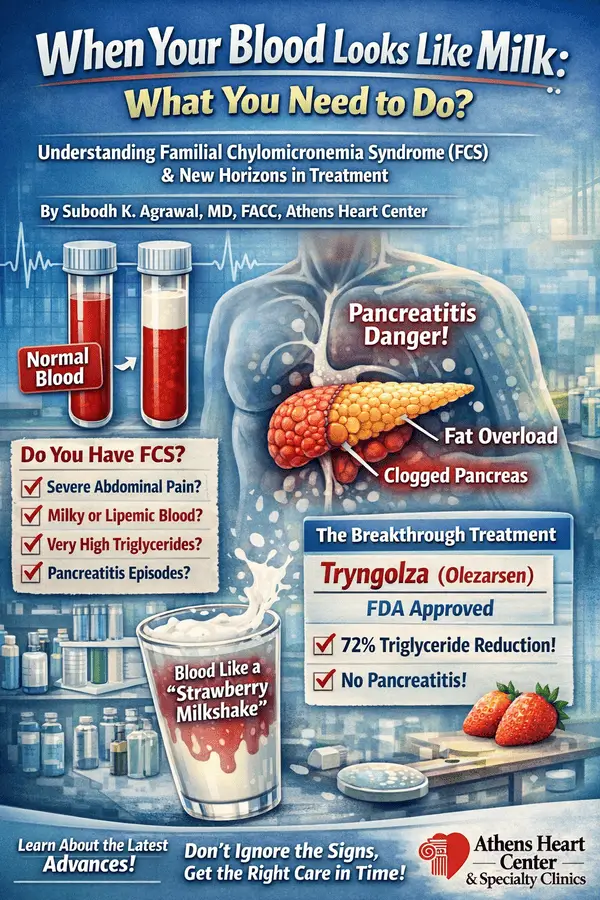
The Science Behind the “Milky” Sample
- Triglycerides accumulate to dangerous levels
- Blood thickens and becomes lipemic
- Small pancreatic vessels become obstructed
- Inflammation develops
- Recurrent pancreatitis follows
The Breakthrough: A New Era of Treatment
For decades, management options were limited to one nearly impossible recommendation: strict dietary fat restriction, often less than 20 grams per day. Even with rigorous compliance, many patients continued to suffer.
Modern medicine has finally offered a better path.
On December 19, 2024, the FDA approved Tryngolza (olezarsen), a targeted antisense oligonucleotide therapy developed specifically for FCS.
Rather than attempting to repair the defective LPL enzyme, this therapy works by targeting Apolipoprotein C-III (ApoC-III), a protein that inhibits triglyceride clearance. By reducing ApoC-III levels, the medication enhances the body’s ability to remove triglycerides from circulation, even in the presence of LPL dysfunction.
The Clinical Proof: The Phase 3 Balance Study
- Patients experienced a 44% to 72% reduction in triglyceride levels compared to placebo
- Lipid profiles improved substantially
- Most notably, there was a 100% reduction in acute pancreatitis events in the core treatment group
Why Early Diagnosis Matters
- The sooner targeted therapy can begin
- The lower the risk of recurrent pancreatitis
- The greater the protection against permanent pancreatic damage
- The better the long-term cardiovascular outlook
A Preventive, Integrated Approach
- On-site advanced lipid diagnostics
- Genetic screening when indicated
- Cardiac imaging, including PET scanning
- Collaborative care between cardiology and endocrinology
- Access to FDA-approved therapies such as Tryngolza
The Bottom Line
If your blood has ever been described as “milky,” that is not a cosmetic detail. It is a biological alarm.
Familial Chylomicronemia Syndrome is rare, but its consequences are severe and preventable with early recognition and modern therapy.
When the bloodstream becomes saturated with fat, the body is signaling distress. Listening to that signal,and acting decisively,can prevent pain, preserve pancreatic function, and safeguard cardiovascular health.
If you or someone you care for meets the criteria outlined above, seek specialized evaluation. Early diagnosis is not just prudent. It is lifesaving.






Share Your Thoughts
No comments yet — be the first to comment!